



Mapping the landscape of commons-based peer production, Peter Troxler analyses the arena of open source hardware and looks into various initiatives being spawned by fabrication labs, trying to identify their business potential and asking how these initiatives contribute to giving people more control over their productivity in self-directed, community-oriented ways.
In today’s society, individuals often collaborate in producing cultural content, knowledge, and other information, as well as physical goods. In some cases, these individuals share the results and products, the means, methods and experience gained from this collaboration as a resource for further development; CO-CREATION this phenomenon is referred to as commons-based peer production.
Commons-based peer production is most widely practiced in the area of software development: open source software. The most prominent examples of open source software are the Linux operating system and the Apache web server. Open source is not the exclusive domain of software, however; it has spread into other domains, from culture and education to knowledge discovery KNOWLEDGE and sharing. Examples include the many people who use Creative Commons licences, CREATIVE COMMONS the Blender movies, VEB Film Leipzig, the countless initiatives in open education, the SETI@home project, Wikipedia, Open Street Map, or Slashdot. Commons-based peer production is generally attributed to digital revolutions: the widespread availability of new, digital information technologies. 1
While its origins can indeed be traced back to digital development, commons-based peer production goes beyond the purely digital domain. A number of open source hardware projects currently aim to produce tangible goods through a peer-production approach, not to mention ‘fabbing’ initiatives (abbreviated from fabrication) that seek to make it possible for anyone to manufacture their own goods.
Perhaps these initiatives are emerging because many “physical activities are becoming so data-centric that the physical aspects are simply executional steps at the end of a chain of digital manipulation”, as Shirky suggests. 2 Then again, perhaps the commons-based peer production model “provides opportunities for virtuous behavior” and so “is more conducive to virtuous individuals”. 3
Yochai Benkler argues that “in the networked information economy – an economy of information, knowledge, and culture that flow through society over a ubiquitous, decentralized network – productivity and growth can be sustained in a pattern that differs fundamentally from the industrial information economy of the twentieth century in two crucial characteristics. First, non-market production (…) can play a much more important role than it could in the physical economy. Second, radically decentralized production and distribution, whether market-based or not, can similarly play a much more important role”. 4 TREND: NETWORK SOCIETY
The business, or rather, the benefits of commons-based peer-production are not uniquely monetary. 5 The rewards include indirect mechanisms, such as the positive effects of learning on future earnings or enhanced reputation, which in turn can lead to future (paid) contracts for consultancy, customization, maintenance or other services. The business also includes what economists call hedonic rewards: not consumption, but the act of creation gives pleasure to the prosumers. Peer recognition is another physiological reward, involving ego gratification. This part of the business is an exchange of production for consumption that does not rely on monetary means.
Open Source Hardware
Since 2006, Philip Torrone and Limor ‘Ladyada’ Fried have been curating Make Magazine’s definitive guide to open source hardware projects MANIFESTOS that started out as a holiday season spending guide to ‘gifts that give back’. 6 Under the heading Million Dollar Baby – probably alluding to the underdog nature of open source hardware – they presented fifteen examples of companies at O’Reilly’s Foo Camp East in May 2010:
Adafruit Industries, makers of educational electronic kits; Arduino, the open source computing platform; Beagle Board, a manufacturer of open development boards for computers; Bug Labs, known for their modular Lego-type computer hardware; Chumby, standalone Internet content viewers; Dangerous Prototypes, Dutch hackers turned entrepreneurs who sell an open source reverse engineering tool; DIY Drones, for open source unmanned aerial vehicles (autopilot drones); Evil Mad Scientist Labs and their fun educational projects; Liquidware, who make Arduino accessories; Makerbot Industries, the company behind MakerBot 3D printers and the sharing platform Thingiverse.com; Maker Shed, the shop behind Make Magazine and Maker Fair; Parallax, education in microcontroller programming and interfacing; Seed Studios, for Chinese Arduino derivatives; Solarbotics, for solar kits, robot kits and BEAM robotics; Spark Fun Electronics, for education and prototyping electronics products.
All these companies are selling open source hardware and creating some kind of community around them. Together, they generate a turnover of about US$ 50m, or so Torrone and Limor estimate. They reckon that there are currently about 200 open source hardware projects of a similar kind. The open source hardware community will reach a turnover of US$ 1b by 2015, according to the forecasts made by Torrone and Limor. Some of these communities have seen exponential growth recently, such as the RepRap community. 7
Kerstin Balka, Christina Raasch and Cornelius Herstatt went to great lengths to collect examples of open source hardware projects through Open-Innovation-Projects.org. In 2009, their database consisted of 106 entries, 76 of which were truly open development of physical products, or open design. Open design as defined on that site is characterized by revealing information on a new design free of charge, with the intention of collaborative development of a single design or a limited number of related designs for market exploitation. Among others, their database includes community projects such as Openmoko, Fab@home, OpenEEG, One Laptop Per Child, SOCIAL DESIGN Mikrokopter, or RepRap.
it is naïve to believe that open source software practices could be copied to and applied in the open design realm without any alteration, ignoring the constraints and opportunities of materiality.
Balka, Raasch and Herstatt used this database of open design projects for statistical studies to identify similarities and differences in open source software projects. 8 They found that, “in open design communities, tangible objects can be developed in very similar fashion to software; one could even say that people treat a design as source code to a physical object and change the object via changing the source”. 9 However, they also find that “open parts strategies in open design are crafted at the component level, rather than the level of the entire design” 10 and that “the degree of openness differs significantly between software and hardware components, in the sense that software is more transparent, accessible, and replicable than hardware”. 11 WYS ≠ WYG Indeed, despite the many academic discussions that support such a view, it is naïve to believe that open source software practices could be copied to and applied in the open design realm without any alteration, ignoring the constraints and opportunities that the materiality of design entails.
Fabbing
Besides these single-aim or single-product projects, there are other initiatives promoting commons-based peer production primarily by sharing designs and encouraging people to ‘make things’. Some are about making things for the fun of it; GRASSROOTS INVENTION the Maker Faire in the USA, Make Magazine and Craft Magazine are all good examples. Some initiatives are about easy sharing, distribution and promotion, such as Ponoko, Shapeways and Thingiverse. Others involve more serious or more ambitious social experiments, such as the Open Source Ecology with their experimental facility, Factor E Farm. 12
And there are initiatives of commons-based peer production that could be summarized under the heading of ‘shared machine shops’. 13 These initiatives are typically centred around workshops equipped with hand tools and relatively inexpensive fabrication machines (e.g. laser cutters, routers, 3D mills). Users produce two-dimensional and three-dimensional objects that once could have only been made using equipment costing hundreds of thousands of euros. They use digital drawings and open source software to control the machines, and they build electronic circuits and gadgets.
100k-Garages is “a community of workshops with digital fabrication tools for precisely cutting, machining, drilling, or sculpting the parts for your project or product, in all kinds of materials, in a shop or garage near you”. 14 Most of these workshops are located in the USA and Canada (about 180), with five shops in Europe and two in Australia. 100k-Garages are essentially establishing a network of distributed manufacturing shops that produce their users’ designs for a fee. They are providing a professional manufacturing service, rather than offering shop access for makers to make their own things themselves. Through quality of workmanship and standardization of equipment – the network is sponsored by ShopBot Industries, a maker of CNC routers – they are establishing a platform which guarantees the making end of it and frees users to focus on design. Ponoko, one of the preferred sharing platforms, enables further exchange.
TechShop is a group of workshops that are equipped with typical machine shop tools (welding stations, laser cutters, milling machines) and corresponding design software. TechShops are mainly based on the ‘gym model’: a monthly subscription buys users access to tools, machines, design software, and other professional equipment. Courses on how to use the tools are offered, too, for a fee. Located in Menlo Park, San Francisco and San Jose, CA, Raleigh, NC, Portland, OR, and Detroit, MI, they cater to a US-based clientele. 15 Chris Anderson describes them as an “incubator for the atom age”; 16 according to his account, the facilities are mainly used by entrepreneurs who come to a TechShop for prototyping and small batch production. The online member project gallery, however, shows such diverse projects as a 3D scan of an alligator skeleton, custom-made sports equipment, movie props, a laser-cut gauge for bamboo needles, a laser-etched laptop and an infrared heater for an arthritic dog.
Hackerspaces are another venue where peer production takes place, self-defined “as community-operated physical places, where people can meet and work on their projects”. 17 Emerging from the counterculture movement, 18 they are “place[s] where people can learn about technology and science outside the confines of work or school”. 19 Equipment and funding are collective endeavours.
A hackerspace might use a combination of membership contributions, course fees, donations and subsidies to sustain itself. Activities in hackerspaces evolve around computers and technology, and digital or electronic art. Hackerspaces are founded as local initiatives following a common pattern. The Hackerspaces ecosystem comprises several hundred member locations world-wide, of which roughly half are either dormant or under construction. 20 Becoming a hackerspace is essentially a matter of self-declaration – an entry on the hackerspaces.org wiki is sufficient – which lowers the barrier to entry enormously, at least for advanced computer users. However, this low barrier to entry is probably also the reason for the relatively large number of ‘registered’ but dormant hackerspaces. Collaboration CO-CREATION between Hackerspaces has recently begun in the form of ‘hackathons’; these marathon sessions currently do not seem to extend beyond displaying the activities happening at the spaces taking part. 21
the open source label confers a certain coolness in some circles of a gadget-crazy world.
Fab Lab, short for fabrication laboratory, is another global initiative with a growing number of locations around the world. Fab Labs have a more conceptual foundation, as they emerged from an MIT course entitled ‘How To Make (almost) Anything’. 22 While there is no formal procedure on how to become a Fab Lab, the process is monitored by MIT, and MIT maintains a list of all Fab Labs worldwide. At the moment of writing, the Fab Lab community COMMUNITY comprises about sixty labs, with another fifty to open in the not-too-distant future. There are a few collaborative projects within the community, and a number of initiatives to exchange designs and experience between the labs. Similar to the hackathons, but occurring more regularly and systematically, all the labs around the world can get in contact with each other through a common video conferencing system hosted at the MIT which is used for ad-hoc meetings, scheduled conferences and the delivery of the Fab Academy training programme.
Academic publications note a number of examples of Fab Lab projects. Mikhak and colleagues report on projects in India, at Vigyan Ashram Fab Lab just outside the village of Pabal in Maharashtra, and at the Costa Rica Institute of Technology in San Jose, Costa Rica. The projects in India are about developing controller boards to facilitate more accurate timing of the diesel engines they use to generate electrical power, and developing devices to monitor milk quality not at the collection centres and the processing plants, but at the producer level. The Costa Rican projects revolve around wireless diagnostic modules for agricultural, educational and medical applications, for example monitoring a certain skin condition in a rural village. 23 SOCIAL DESIGN
In FAB: The Coming Revolution on Your Desktop, Neil Gershenfeld lists examples of what students at MIT made in his course on ‘How to Make (almost) Anything’. The list includes a bag that collects and replays screams, a computer interface for parrots that can be controlled by a bird using its beak, a personalized bike frame, a cow-powered generator, an alarm clock that needs to be wrestled with to turn it off, and a defensive dress that protects its wearer’s personal space. 24
Arne Gjengedal reports on the early projects at the Norwegian MIT Fab Lab at Solvik farm in Lyngen. His list includes the ‘electronic shepard’ (sic) project that used telecom equipment RECYCLING to track sheep in the mountains, the ‘helmet wiper’ for clearing the face shield in the rain, the ‘wideband antenna’ for the industrial, scientific and medical (ISM) radio band, the ‘Internet 0’ project for a low-bandwidth internet protocol, the ‘perfect antenna’, and the ‘local position system’ for positioning of robots in the lab. 25
Diane Pfeiffer describes her own experiments and projects in the context of distributed digital design. Her experiments were Lasercut News, Digital Color Studies & Pixelated Images, Lasercut Screen, and Lasercut Bracelets (which she sold at a local shop); the projects she worked on were Distorted Chair and Asperatus Tile. 26
The Business Promise
All those initiatives represent various aspects of a commons-based peer production ecosystem (non-market or radically decentralized production) or are at least contributing to the emergence of such an ecosystem.
Torrone and Fried have shown how a regular and sizeable market has grown around open source hardware. Those open source hardware businesses clearly operate under market conditions and their production is not radically decentralized. Indeed, Torrone and Fried’s agenda might even be said to ‘prove’ that open source hardware results in marketable products. Evidently, the open source label confers a certain coolness in some circles of a gadget-crazy world. OPEN EVERYTHING
Yet many of these open source hardware components – Arduino and MakerBot being the most prominent examples – are providing open source ingredients to a peer production ecosystem at a price that outweighs the pain of sourcing all the parts, having to deal with manual assembly, or facing issues of incompatibility. As components, they can become building blocks of higher-order machines. In that sense, they function as a platform for open source development. As far as the components themselves are concerned, they are open source in the sense that their internal structure and functioning are made transparent and potentially modifiable. BLUEPRINTS
As flat-packed, self-assembly, open source machines, they are the choice of many peer-producers and form an important basis for highly decentralized – and highly customized – production. It becomes possible to own machines at the price of building them rather than the price of buying them pre-assembled. DOWNLOADABLE DESIGN And their open source nature makes it easier to adapt them to specific requirements or even repurpose them in novel ways.
Rather than commoditizing ingredients, 100k-Garages commoditize one part of the making process: the cutting. If there is a dense enough network of such facilities in any particular region, this makes a certain practical sense in terms of efficiency and safety, given the somewhat demanding fabrication process of a ShopBot CNC router as compared to a laser cutter. However, it establishes a division of labour, and it deprives user-clients from accessing potential learning experiences and therefore potentially contributing to a more general commons. The result is that the ShopBot remains a commons apart, and somewhat closed at that.
TechShops, Hackerspaces and Fab Labs are all providing facilities and knowledge as part or rather as a basis of a commons. The environment in which TechShops operate is strictly commercial. Peer production might happen by accident, but there seem to be no incentives to support it. As an ‘incubator for the atomic age’, they remain safely in the market arena, yet they are effectively creating opportunities for decentralized prototyping and production.
In contrast, Hackerspaces live up to their name, definition and history by building on non-market, sometimes even anti-market MANIFESTOS commons-based principles. Their core focus is doing personal and collective projects. And Hackerspaces are far from exclusive; they frequently include casual users who might spend a lot of time in hackerspaces. Nick Farr even speculates that those casual users are “perhaps making more significant contributions than regular members, but decline to officially join for many different reasons.” 27
The Fab Labs’ commitment to a commons is clear from how they are structured. Fab Labs subscribe to a charter which, among other things, stipulates open access, establishes peer learning as a core feature and requires that “designs and processes developed in fab labs must remain available for individual use”. In the same clause, however, the charter also allows for intellectual property to be protected “however you choose”. Underlining this point, it explicitly continues that “commercial activities can be incubated in fab labs”, while cautioning against potential conflict with open access, and encouraging business activity to grow beyond the lab and to give back to the inventors, labs, and networks that contributed to their success. 28 Fab Labs incorporate an interesting mix of characteristics that might seem contradictory at first, but might well be considered the best practical approximation of Benkler’s networked information economy. TREND: NETWORK SOCIETY
‘Libraries’ of the Peer Production Era
The fabbing universe could be described on two dimensions, characterizing initiatives as more reproductive or more generative in their nature, and as more infrastructure-oriented or more-project oriented in their approach.
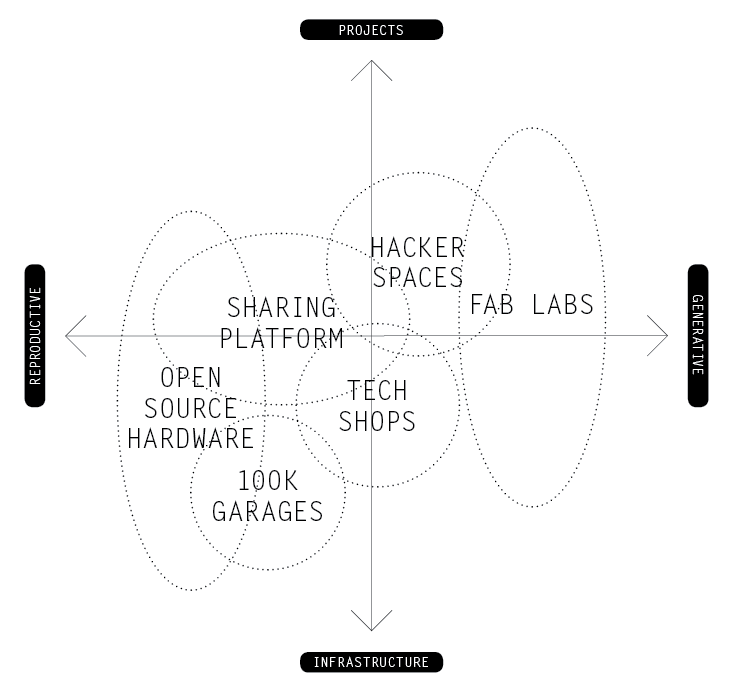
Books, Libraries, and the Choices of Self-Directed Productivity
Open source hardware – as components or production equipment – not only embodies the technical knowledge of products and production the way that traditional components and machines once did. In sharp contrast to the opaque and impenetrable black boxes of advanced 20th-century engineering, WYS ≠ WYG they give users access to that knowledge as a result of their open source design. Akin to books, which seem meaningless to people who cannot read, but open their content to those who have achieved literacy, open source hardware reveals its technicalities to those who grasp that language.
If open source hardware can be compared to the ‘books’ of commons-based peer production, then TechShops, Hackerspaces and Fab Labs are its libraries. Traditional libraries act as common points of access to knowledge coded in books, and in fact offer locations where knowledge can be produced. Similarly, copy shops allow anybody to produce their own range of print products, from cards to books, T-shirts and mugs. Cyber-cafés also provide access to knowledge, as locations where everybody can link into a common information and communication infrastructure. Those new labs are the places that provide general access to the tools, methods and experience of peer production. Indeed, the National Fab Lab Bill presented to the US Congress in 2010 EVENT argues along these lines, aiming “to foster a new generation with scientific and engineering skills and to provide a workforce capable of producing world class individualized and traditional manufactured goods”. 29
The business proposals of open source hardware and the various fabbing initiatives are not equally straightforward in every case. As discussed, commons-based peer production has found ways to generate monetary returns by selling open source products, charging memberships fees in open source communities, or providing paid education and manufacturing services. To some extent, the strong appeal of commons-based peer production can probably be attributed in part to its hedonic rewards: the pleasure of being creative, the pride of recognition by peers, the feeling of achievement and status. However, there are no clear examples of indirect mechanisms deriving tangible benefits from these hedonic rewards, such as makers getting corporate development assignments or contracts as product managers thanks to their reputation in open hardware design. If such examples exist, they are not being discussed openly. And commons-based peer production has yet to realize its potential as a platform for many more developers and producers to generate a substantial income under market or non-market conditions.
As Yochai Benkler notes, it is “important to see that these efforts mark the emergence of a new mode of production, one that was mostly unavailable to people in either the physical economy (…) or in the industrial information economy.” 30 The initiatives of commons-based peer production give more people more control over their productivity in self-directed and community-oriented ways. The variety of the initiatives give people a range of fundamentally different options to choose from, and indeed requires them to make those choices instead of accepting a mode of consumption that has been predetermined by a lobby of the current “winners in the economic system of the previous century.” 31
Even if the emergence of open source hardware and fabbing initiatives only dates back a few decades, commons-based peer production is still in its early days. Nobody knows yet whether the one and only correct, long-lasting and sustainable approach to this new mode of production has been found yet – or even if such a uniform approach will ever emerge.
REVOLUTION It seems much more likely that the current trend will develop into a plethora of different models that embrace various aspects of commons-based peer production, with users switching between different models as appropriate. It will be interesting to see whether and how traditional businesses will be able to adapt to a new reality of real prosumer choice.
- See e.g. Benkler, Y, The Wealth of Networks. How Social Production Transforms Markets and Freedom. New Haven and London, Yale University Press, 2006. ↩
- Shirky, C, ‘Re: <decentralization> Generalizing Peer Production into the Physical World’. Forum post, 5 Nov 2007 at finance.groups.yahoo.com/group/decentralization/message/6967 , accessed on 30 August 2010. ↩
- Benkler, Y and Nissenbaum, H, ‘Commons-based Peer Production and Virtue’, The Journal of Political Philosophy, Vol. 14, No. 4, 2006, p. 394. ↩
- Benkler, Y, ‘Freedom in the Commons: Towards a Political Economy of Information’, Duke Law Journal, Vol. 52, 2003, p. 1246f. ↩
- See also Benkler, Y, ‘Coase’s Penguin, or, Linux and The Nature of the Firm’, The Yale Law Journal, Vol. 112, 2002. ↩
- Available online at blog.makezine.com/archive/2006/11/the_open_source_gift_guid.html ↩
- Jones, R, Bowyer, A & De Bruijn, E, ‘The Law and the Prophets/Profits’. Presentation given at FAB6: The Sixth International Fab Lab Forum and Symposium on Digital Fabrication, Amsterdam, 15-20 August 2010. Available at cba.mit.edu/events/10.08.FAB6/RepRap.ppt , accessed 30 August 2010. ↩
- Balka, K, Raasch, C, Herstatt, C, ‘Open Source beyond software: An empirical investigation of the open design phenomenon’. Paper presented at the R&D Management Conference 2009, Feldafing near Munich, Germany, 14-16 October 2009. See also: Balka, K, Raasch, C, Herstatt, C, ‘Open Source Innovation: A study of openness and community expectations’. Paper presented at the DIME Conference, Milan, Italy, 14-16 April 2010. ↩
- 2009 study, p. 22. ↩
- 2010 study, p. 11. ↩
- Idem. ↩
- Dolittle, J, ‘OSE Proposal – Towards a World-Class Open Source Research and Development Facility’. Available online at openfarmtech.org/OSE_Proposal_2008.pdf , accessed 6 June 2010. ↩
- Hess, K. Community Technology. New York: Harper & Rowe, 1979. ↩
- 100kGarages. Available online at www.100kgarages.com , accessed 30 August 2010. ↩
- TechShop is the SF Bay Area’s only open-access public workshop. Available online at techshop.ws/ , accessed 30 August 2010. ↩
- Anderson, C, ‘In the Next Industrial Revolution, Atoms Are the New Bits’, Wired, Feb. 2010. Available online at www.wired.com/magazine/2010/01/ff_newrevolution/all/1 , accessed 4 June 2010. ↩
- HackerspaceWiki. Available online at hackerspaces.org/wiki/ , accessed 30 August 2010. ↩
- Grenzfurthner, J, and Schneider, F, ‘Hacking the Spaces’ on monochrom.at, 2009. Available online at www.monochrom.at/hacking-the-spaces/ , accessed 30 August 2010. ↩
- Farr, N, ‘Respect the past, examine the present, build the future’, 25 August 2009. Available online at blog.hackerspaces.org/2009/08/25/respect-the-past-examine-the-present-build-the-future/ , accessed 30 August 2010. ↩
- List of Hackerspaces. Available online at hackerspaces.org/wiki/List_of_Hacker_Spaces , accessed 30 August 2010. ↩
- Synchronous Hackathon. Available online at hackerspaces.org/wiki/Synchronous_Hackathon , accessed 30 August 2010. ↩
- Gershenfeld, N, FAB: The Coming Revolution on Your Desktop. From Personal Computers to Personal Fabrication, Cambridge: Basic Books, 2005, p. 4. ↩
- Mikhak, B, Lyon, C, Gorton, T, Gershenfeld, N, McEnnis, C, Taylor, J, ‘Fab Lab: An Alternative Model of ICT for Development’. Paper presented at the Development by Design Conference, Bangalore, India, 2002. Bangalore: ThinkCycle. Available online at: gig.media.mit.edu/GIGCD/latest/docs/fablab-dyd02.pdf , accessed 11 July 2010. ↩
- Gershenfeld, op.cit. ↩
- Gjengedal, A, ‘Industrial clusters and establishment of MIT Fab Lab at Furuflaten, Norway’. Paper presented at the 9th International Conference on Engineering Education, 2006. Available online at: www.ineer.org/Events/ICEE2006/papers/3600.pdf , accessed 3 March 2010. ↩
- Pfeiffer, D, Digital Tools, Distributed Making & Design. Thesis submitted to the faculty of the Virginia Polytechnic Institute and State University in partial fulfilment of the requirements for the Master of Science in Architecture. Blacksburg, VA: Virginia Polytechnic Institute and State University, 2006. ↩
- Farr, N, ‘The Rights and Obligations of Hackerspace Members’, 19 August 2009. Available online at blog.hackerspaces.org/2009/08/19/rights-and-obligations-of-hackerspace-members/ , accessed 31 August 2010. ↩
- Fab Charter, 2007. Available online at fab.cba.mit.edu/about/charter/, accessed 11 January 2011. ↩
- H.R. 6003: To provide for the establishment of the National Fab Lab Network (…). Available online at www.govtrack.us/congress/billtext.xpd?bill=h111-6003, accessed 13 Oct 2010. ↩
- Benkler, Y, ‘Freedom in the Commons: Towards a Political Economy of Information’, Duke Law Journal, Vol. 52, 2003, p. 1261. ↩
- Idem, p. 1276. ↩