



The mediocracy of the middle classes dominates the current mass production design. In a world less controlled by branding and regulations, a new breed of designers can contribute to an altered, more honest economy. An interview with Dutch designer Joris Laarman, contemplating his relationship to modernism and the modernist roots of open source design and digital fabrication.
There’s always something special about the top crop of Dutch design graduates, but every once in a while one comes along that makes everyone sit up and take notice. In 2003, that was Joris Laarman. His Reinventing Functionality project at the Design Academy of Eindhoven fused function with ornament and was snatched up by Museum Boijmans Van Beuningen in Rotterdam.
Design must accept some of the responsibility for creating many of the world’s current problems.
Since then, he has earned a reputation for himself as a designer with visionary ideas and a concern for societal issues. His first project out of school, the Bone Furniture range, was exhibited in the Friedman Benda gallery in New York, a limited edition series made from marble, porcelain and resin. While he calls it an “annoying coincidence” that much of his work has spawned major contemporary trends, it also testifies to its relevance to the issues that matter.
Furniture That Can Be Grown
Both those early projects clearly expressed Laarman’s highly specific views on modernism. The Bone range DESIGNERS resulted from a cooperative partnership with car manufacturer Opel, using software to design a series of artworks based on the organic way that bones form. Car parts are designed with the help of topology optimization software to increase strength and maximize the efficient use of materials. Furniture, as it turns out, can also be ‘grown’ by adding and removing material to maximize its strength and functionality.
Laarman’s stance is that functionality and extravagance are not mutually exclusive. Where modernism went wrong, and how its core advantages need to be readdressed, are what drive his research. What he is looking for are design solutions that possess a revolutionary quality. Much of his current research repudiates how things are currently done and patiently pursues a better way not just to manufacture, but also to distribute design.
Seen in this light, design must accept some of the responsibility for creating many of the world’s current problems. More importantly, it can play a key role in fixing them. In 2009, Laarman opened his Amsterdam studio to the public for the first time. His purpose was to share his thinking and his process. He wanted to reveal how design experimentation and research can create answers, not just pretty objects.
“In galleries and in Milan, people only ever see perfect pieces,” he says. “In this exhibition, I wanted people to see the research part of design, what is behind all the pretty shapes, and how they could eventually be of use in the world. I wanted people to understand what the future of design could look like using technological progress.”
Laarman hit a wall when he was researching open source design and digital fabrication. He realized that design had taken a wrong turn somewhere along the way and was now failing society. “I am not necessarily against how design is now,” he says, “but I do think the internet can provide a more honest way to design, make, distribute and sell things.” Not modernism, then; what’s needed is a new -ism. It takes some audacity for such a young designer to criticize the industry. Laarman has gone beyond theoretical criticism, underlining his opinion with some tangible ideas that he wants to try out – hopefully with the support of his contemporaries.
I do think the internet can provide a more honest way to design, make, distribute and sell things.
“I started to think of my work and of design in general as a sort of laboratory,” Laarman says. He explains it as a place where solutions might be found to the predicament created by over-production in the post-industrial age. “I’m not condemning the whole design industry,” he says, “or even questioning it. There is a lot of very good industrial production, and that will never go away, but I think it will soon be joined by another revolution made possible by the internet.” REVOLUTION
Despite its failures and the role it played in creating over-production, Laarman’s research kept bringing him back to modernism – not as an aesthetic per se, but as a philosophy. In 2010 Laarman was selected by Ingeborg de Roode, curator of industrial design at the Stedelijk Museum in Amsterdam, to participate in the Modernism Today series. “I guess she sees me as a sort of contemporary version of Rietveld,” DESIGNERS says Laarman. “That is an interesting comparison, and I see some connection.” 100 years ago, Gerrit Rietveld experimented with technology and materials; Laarman does the same today. His aesthetic is not in the tradition of De Stijl, but his values most certainly are.
The Modernist Roots (of Open Design)
In line with those values, it made good sense to fuse Rietveld’s world of ideas and experiments with open source design and digital fabrication; both could be argued to have modernist roots. Open source has been revolutionizing the cultural content universes of music and software for almost a decade, so why shouldn’t it also be able to change the way design is both made and distributed?
“I think true modernists wanted open source design one hundred years ago,” says Laarman, “but back then it wasn’t possible. Rietveld published manuals about how to make his chairs, but nobody could really use that information, because there were no networks of skilled artisans. His designs look simple, but are difficult to construct. These days, we can distribute knowledge in a way that can potentially bring craftspeople back to the centre stage of design – not in an idealistic, naïvely romantic way, but in an economically sound way. All we need are the networks, and cheaper and more accessible digital manufacturing technology.” One of modernism’s core flaws was the huge amount of power that ended up in the hands of a few big factories and design firms. The movement was supposed to be about the democratization of design – that was their big idea – but somewhere along the line it became nothing more than an aesthetic. Of course there are some obvious differences between modernism and open source design. Modernism produced an international and generic style. Industrialization led to mass production, which meant production had to be centralized and its products transported across the globe from countries with the lowest wages at great environmental and economic expense. Information and knowledge were kept closed and protected by copyrights; even if they had been accessible, it would have been impossible for an individual to use the design data without access to exorbitantly expensive production tools. The quality of design produced was and continues to be guaranteed by the producer; in turn, the producer and the retailer divide the majority of sales revenues.
I think true modernists wanted open source design one hundred years ago.
Open source design, on the other hand, has the capacity to conserve culture and decoration as well as traditional skills by utilizing new technology.
Digital production makes mass customization possible. Open source makes information and knowledge public; in addition, it has low entry costs, quality control takes place in the form of peer review by the public, and revenues are divided between craft and creativity. Also, because the products of open source design can be produced locally, transportation costs are drastically reduced.
What open source design does is redistribute knowledge KNOWLEDGE and the means of production. It has the potential to change everything that we know about design, from manufacturing to education. Open source design is anti-elitist insofar as it can create fairer and more honest prices. It is democratic and helps to create self-determination in an individual’s immediate environment. Ultimately, it takes power away from the huge multinationals and from production hubs like China and India and hands it back to craftspeople – those individuals rendered irrelevant by industrialization. In short, open source design could feasibly become this century’s new -ism.
Ultimately, it takes power away from the multinationals and production hubs like China and hands it back to craftspeople – those individuals rendered irrelevant by industrialization.
“This does not mean that anyone can make good design or that more rubbish can be produced,” Laarman says. “Just because everyone has a digital camera doesn’t mean that everyone is a photographer. I am not in favour of amateurism, but the way I envision the system working, the good will eventually be filtered from the bad.” AMATEURISSIMO
Less Production Is Needed, Not More.
Statistics show that up until the Industrial Revolution, a similar amount of products were being produced every year. With industrialization came increased wealth and prosperity, which lead to massive increases in production. The result was more waste, more environmental damage TREND: SCARCITY OF RESOURCES and a surge in unemployed artisans. The average Western person today has access to more things than Queen Victoria owned during her reign. “The tragedy is that the vast majority of what is being today made lacks creativity and quality and isn’t really needed,” Laarman says. “The over-production of mediocrity for the middle classes has created a difficult economic situation, and there is nothing that can be done about it within the current system.”
If digital design went local, imagine what this would mean for small producers. “Right now, most people are just talking about digital fabrication,” says Laarman, “but it is happening, and I think can eventually take over. I am not going to say it will change the world, but it will change the way things are made. 3D printing is still very limited, AESTHETICS: 3D
especially in terms of materials, but as digital manufacturing technology evolves, anything is possible.”
One possible scenario would be for local communities to invest in technology. “There are already all kinds of initiatives popping up that give individuals the opportunity to start their own small production facilities,” Laarman says. “We are looking into setting up a sort of professional Fab Lab, for instance, where any design based on a digital blueprint could be mass-customized and made.”
It could work. The RepRap machine, for example, is an open-branded DIY 3D printing machine. HELLO WORLD The RepRap is a machine that you can make yourself (and that can reproduce itself!) REPRODUCTION that can in turn make other gadgets. “Right now, this sort of thing is the domain of geeks for geeks, but once it becomes more professional, it will be ready for more general usage,” Laarman says.
The average Western person today has access to more things than Queen Victoria owned during her reign.
Open source design and local digital fabrication could also revolutionize education, which has mostly become outdated and irrelevant. “We could tie the platform into trade schools,” Laarman says. “Education has fallen behind and kids are not being taught what is needed. Digital manufacturing should be taught in schools, especially at the vocational school level.”
These developments are slow, however, because open source design remains the great unknown, with many unanswered quandaries. The new, innovative nature of the ideas works both for and against them; instead of inspiring images of a world less controlled by branding and regulations, open source design ends up sounding chaotic, with too much choice and an over-abundance of experimentation and waste. Issues of copyright and profit-sharing scare off many, leaving a lot of the earliest experimental platforms looking unprofessional and insecure. MANIFESTOS
But the problem for most of the current websites selling open source design is they lack professional participation. What’s needed is more of the best and most visionary design minds debating and devising ways to make it all work. “What is happening so far isn’t really making a difference, but it does show that there is huge potential,” Laarman says.
Creative Commons CREATIVE COMMONS has made some interesting inroads. It is a new type of copyright that protects a designer (or anyone else) so that they can make licensing agreements with suitable producers or limit use of their ideas to personal use only. “It works in an idealistic sense if everybody plays nice,” says Laarman. It is still limited, though, and resembles a small-scale iTunes dominated by amateur musicians playing a limited number of instruments. What is needed next is a professional digital platform, or a network where people can meet, access and share information about how and where to have design digitally manufactured.
Digital manufacturing should be taught in schools, especially at the vocational school level.
Make-Me .com
One exciting project already under way, albeit in its nascent stages, is Make-Me.com, a cooperative venture involving Laarman, the Waag Society, Droog Design and some early internet pioneers. For designers, it means uploading their design for general distribution. For consumers, it means being able to access and customize design. For local producers, it means using licensing agreements to make the things that people want. “It reduces our carbon footprints and allows for more customization,” says Laarman.
That is what we do. We take something from the past and shape it into something new.
Make-Me.com plans to operate like an app store. You go there to get what you want. Some of it is free and some of it is paid for; some are designed by amateurs and some by professionals. “The amateurs and the professionals have to compete against one another,” Laarman says. “You find the chair you want online via us and you go to the local Fab Lab to have it produced on the spot. The platform is linking consumers to craftspeople and digital fabrication tools.”
Make-Me.com as an open source platform is not limited to design. “It is for journalists, architects, businesspeople, scientists – even a place you could go to for a new haircut,” says Laarman. Big pharmaceutical companies, for example, don’t want to invest in research on diseases that only affect small numbers of people, because there is no money to be made. An open source platform could open up possibilities for DIY bio-labs where scientists and doctors could access research and make their own medicines. “Anyone can use Make-Me.com to distribute information in a new way.”
Designers, however, fear what all this means for them in terms of copyright. They think production companies protect their intellectual property, the quality of their designs, and guarantee them an income. What that fails to recognize is that copyright is a complicated question. Who really owns an original idea? Is anything truly and completely original? Every creative person pilfers and borrows ideas from everywhere; referencing what came before is a natural part of the creative process. “That is what we do,” says Laarman. “We take something from the past and shape it into something new.” REMIX Via Creative Commons licensing, it might become possible to profit from someone stealing your idea.
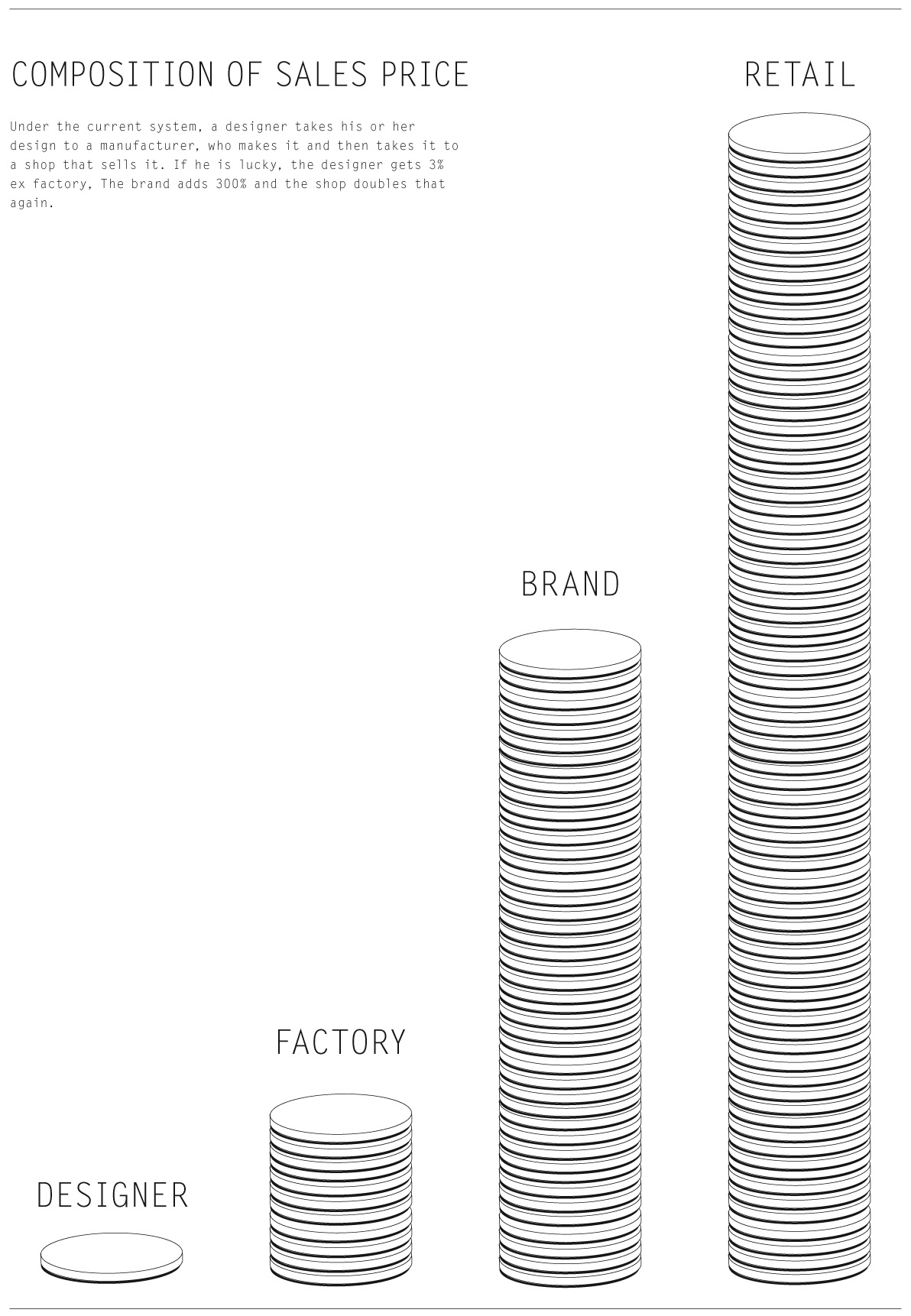
What limits the scope of open source at this point goes beyond legal concerns. For it to work, a whole new economic model would need to be devised and accepted. Under the current system, a designer takes his or her design to a manufacturer, who makes it and then takes it to a shop that sells it. “If he is lucky, the designer gets 3% ex factory,” Laarman says. “The brand adds 300% and the shop doubles that again. It’s ridiculous how little of the cut a designer gets. If we used digital tools and changed the way stores work, the ratio would be able to favour creativity and the craftsman.”
However, test-driving a new model will require a platform like Make-Me.com. It has to be large scale, and it will need to attract big-name designers and brands so that people can see it working. It’s a tough chicken-and-egg situation: unless designers feel that their financial income and copyright dues are guaranteed, they are not going to take the risk – and without enough designers taking the risk, it will be virtually impossible to erect the solid infrastructure to ensure smooth, safe and legal operations. It will take a coordinated leap of faith from educational facilities, designers and craftspeople for anything like this to work.
None of these obstacles are insurmountable. What Laarman wants is to be a part of the experiment and to be a contributing member of that generation who will be defining the parameters and creating the way forward. It is that vision which distinguishes him from a lot of his contemporaries – he has the commitment and the patience. He knows that this is something big and wants to do whatever it takes to make it work. “Right now, I am making very expensive, limited-edition designs,” he says. “That is a good way to fund the experiments and start a business, but eventually what I’d like to be able to do is provide open source versions of my work for everyone. That is my goal.”
He knows he doesn’t have all the answers, but Laarman is working through all these problems one by one. “I don’t want to say that this idea could take over the entire production world,” he says, “but it can certainly help craftspeople to make things that are not standardized or mass produced. If a world-wide network of craftspeople grows, then this could potentially really change things.”
Closed Societies Fail
Whichever way you look at this, design cannot continue as is. Design reveals a lot about society, and closed societies fail; like organisms that shut themselves off from their environment, a society that shuns reality will eventually die. Likewise, closed design is outdated. Open source, whether it can be what designers want or even understand at this point, is one way for design to play a real role in building a new, more honest economy. A world with less mass production, less waste, less transportation and less standardized design STANDARDS can only be interpreted as a win-win situation for all concerned.
Another decade of discussion is needed before open source design will ever be able to make a tangible difference. Interestingly, the same arguments being used against the phenomenon now are the very same arguments that were once used against the introduction of democracy. The ruling elite will always feel threatened by the idea of giving power to the people.
What I’d like to be able to do is provide open source versions of my work for everyone.